Saturday, November 28, 2015

Thursday, November 26, 2015
I really want to know You…
[embed]https://youtu.be/ELOe3f-hihc[/embed]
From Concert for George.
At the end, Billy Preston turns and gives Ringo a thumbs up, and Ringo responds by holding his sticks high in the air. They know they nailed it.
From Concert for George.
At the end, Billy Preston turns and gives Ringo a thumbs up, and Ringo responds by holding his sticks high in the air. They know they nailed it.
Tuesday, November 24, 2015
"I'd give you everything I've got for a little piece of mind…"
[embed]https://youtu.be/EXHOaj22HZw[/embed]
Monday, November 23, 2015
Ahhhhhhhh…
[embed]https://youtu.be/9yuEboyB6og[/embed]
I'm in that crowd somewhere.
It was one of the happiest moments of my life.
I'm in that crowd somewhere.
It was one of the happiest moments of my life.
Sunday, November 22, 2015
Brevity
Another excerpt by Billy Collins from his introduction to Haiku in English, edited by Jim Kacian, ©2013:
Haiku is both easy and impossible to define. One can merely use dictionary language to say that a haiku is a short poem, usually in three lines, that uses natural imagery to evoke a feeling or mood. But such flat definitions fall well short of accounting for haiku's mysterious power to cause in the reader's consciousness a sudden shift, literally a new way of seeing. Part of this ability lies in the form's brevity, which leaves no time to explain an experience; instead, the haiku conveys an experience directly without commentary and with an immediacy not possible in longer poems.
Saturday, November 21, 2015
Words
I’m reading an autobiography written in the 1940s, and came across the sentence
Clearly the word didn’t mean then what it means now, and I was having a heck of a time figuring out what he meant until I found an online Webster's Dictionary from 1828 that cleared up the confusion: it used to mean “short and fat.”
I was pussy.
Clearly the word didn’t mean then what it means now, and I was having a heck of a time figuring out what he meant until I found an online Webster's Dictionary from 1828 that cleared up the confusion: it used to mean “short and fat.”
Was Here
Billy Collins writes of haiku in the introduction to Haiku in English, edited by Jim Kacian, ©2013:
Many people don't get haiku. They typically ask what the big deal is about a frog leaping into a pond or a piece of green pepper falling off a salad bowl. So what indeed? Maybe the best answer is a slap on the face, a common "answer" to a baffling koan. But a more reasonable explanation of the "big deal" is the irreducible fact that the poet was there to witness the event. A cherry tree in blossom and a dog barking in the distance may not seem to add up to much, but what such a haiku declares is that someone was present--actually there, living and breathing--at that particular intersection of sight and sound. In that sense, haiku not only convey the beauty of individually experienced moments, they are also powerful little assertions of the poet's very existence. Not to be present to witness the cherry tree and the barking dog means being absent, perhaps non-existent. Every haiku makes a common claim: I was there! Like Kilroy with his nose over the fence.
Friday, November 20, 2015
My Cup
[embed]https://youtu.be/xvaQisHV8jw[/embed]
His politics are abhorrent, but my God what a voice!
His politics are abhorrent, but my God what a voice!
Thursday, November 19, 2015
Little People
One of the pleasures in reading mid-20th century autobiographies is the easy candor with which they report supernatural experiences. This is from The Autobiography of William Allen White, ©1946:
One thing I remember-- a strange thing and quite mad. The August harvest moon, under which a few nights before I had come home feeling most poetical from my day's fishing with my visiting editors, was still shining high in the sky when I walked home another night, either from the Imperial Club dance or from our serenading, or from an evening on Walnut Hill with Alice Murdock, her family and maybe two or three young people sitting on the porch, not unconscious of the night's splendor. I turned in and slept deeply. Then I remember waking up, when the moon's beams were slanting and the dawn must have been but two or three hours away. Now this is sure: I did wake up. Something-- it seemed to me the sound of distant music-- came to my ear. The head of my bed was near a south window, and I looked out. And I will swear across the years during which I have held the picture, that there under a tree-- a spreading elm tree-- I saw the Little People, the faeries. I was not dreaming; at least I did not think so then, and I cannot think so now. They were making a curious buzzing noise, white little people, or gray, three or four inches high. And I got up out of bed and went to another window, and still saw them. Then I lay on my belly on my bed and kicked my heels and put my chin in my hands, to be sure I was not sleeping, and still I saw them. For a long time, maybe five minutes, they were buzzing about, busy at something, I could not make out what. Then I turned away a moment, maybe to roll over on my side or get up on my knees, and they began to fade away; and instant later they were gone. And there I was, like a fool, gawking at the bluegrass under the elm. I got up and sat in a chair. I was deeply upset, bemused, troubled. I thought maybe I was going crazy! I knew well enough of course, even then, that what I saw I did not see; but when you are cold sober, and have the conviction spread over you that you are mad, you are bothered-- and I have been bothered ever since. It is not impossible. Nothing is impossible. Many years later I heard of transparent fish; with other eyes, other creatures see other things; with other ears they hear much that escapes our human ears. Perhaps in our very presence are other beings like the transparent fish, which we may not feel with our bodies attuned to rather insentient nerves. Heaven knows! For an hour I thought I was crazy. And when I recall that hour, and am so sure that I was awake, I think maybe I am still crazy.
Peace and Flowers
If you pluck all of the weeds out of a field, it's not going to magically fill with flowers. If you stop at this point, all that's going to happen is the field will fill back up with weeds. If you want flowers, you have to plant them.
That's what's wrong with America's Middle East policy. It's not enough just to kill the weeds- if you want something better, you have to plant it.
That's what's wrong with America's Middle East policy. It's not enough just to kill the weeds- if you want something better, you have to plant it.
Tuesday, November 17, 2015
That Little Girl
Passages like this one are the reason I love The Autobiography of William Allen White so much:
Had he been a president or a senator, rather than a simple Midwest newspaperman, his book would be crowded with awards and ceremony and listings of Great Deeds. There would have been no room for charming little anecdotes like this one.
I stopped at the home of a girl whom I knew at the university but slightly. I could not rouse the family at the front door, so I walked around the house to the kitchen porch, where she stood with her back to me, ironing. I said, "Laura," and without a word she whirled and literally jumped into my arms, crying, "Oh, George!" She blushed to a crisp when she found her mistake. I see her every year now at commencement. We are old folks, and George-- Heaven knows where he is. But he was never loved in his long life as that little girl must have loved him.
Had he been a president or a senator, rather than a simple Midwest newspaperman, his book would be crowded with awards and ceremony and listings of Great Deeds. There would have been no room for charming little anecdotes like this one.
The Man with the Horn
[embed]https://youtu.be/nfYFEPQ-gY0[/embed]
Music is much more striated now than it used to be. I miss the days when you could listen to Kasey Kasem and hear all kinds of different things.
Music is much more striated now than it used to be. I miss the days when you could listen to Kasey Kasem and hear all kinds of different things.
Monday, November 16, 2015
Sunday, November 15, 2015
Moon
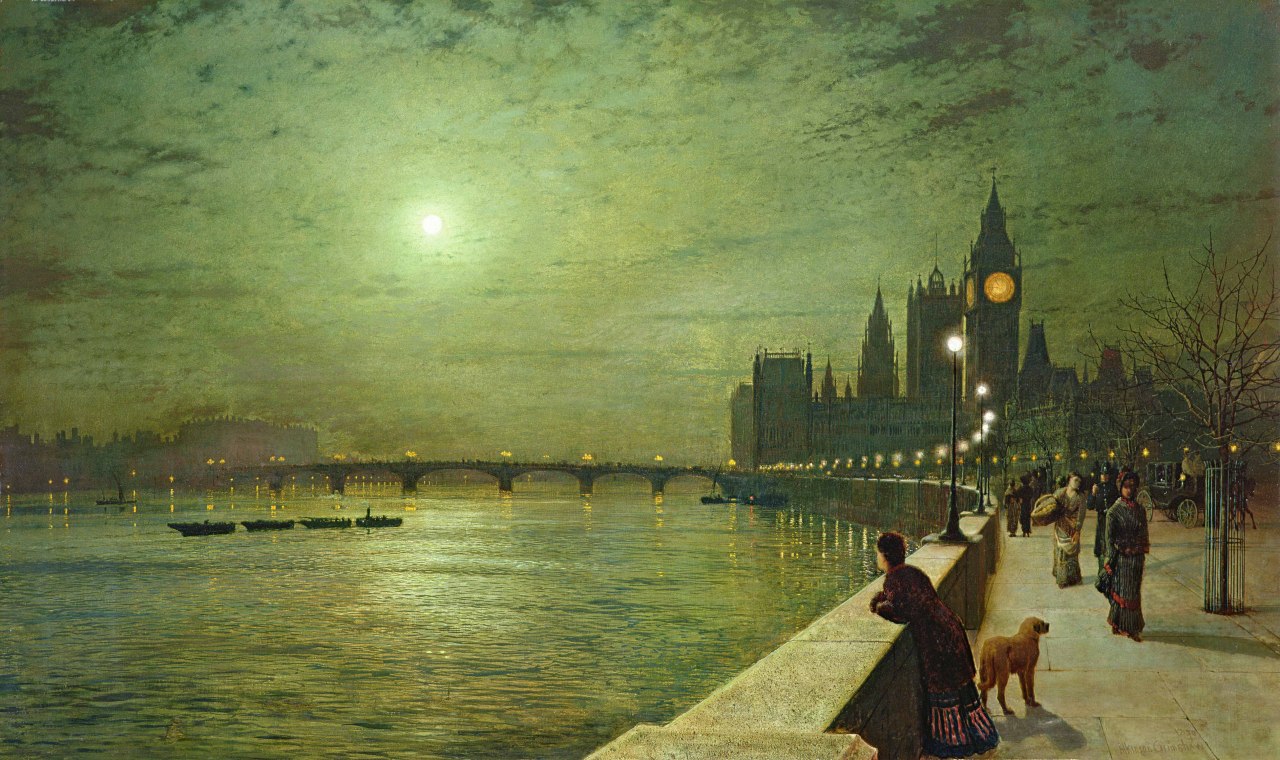
Reflections on the Thames, Westminster, 1880
John Atkinson Grimshaw painted some of the most stunning night scenes I've ever seen.
Subscribe to:
Posts (Atom)