Showing posts with label haiku. Show all posts

Monday, January 15, 2024

Welcome

Will you start a fire?
I'll show you something nice:
a giant snowball
~Bashō


And that reminded me of this:

The Pasture
By Robert Frost

I'm going out to clean the pasture spring;
I'll only stop to rake the leaves away
(And wait to watch the water clear, I may):
I sha'n't be gone long.—You come too.

I'm going out to fetch the little calf
That's standing by the mother. It's so young,
It totters when she licks it with her tongue.
I sha'n't be gone long.—You come too.


I'm re-reading Bashō and His Interpreters:  Selected Hokku with Commentary by Makoto Ueda, ©1992, and I recommend it to anyone with even a passing interest in Asian poetry.

It's very accessible.  Each page has a haiku (or one of its myriad variations) followed by the original Japanese, a paragraph explaining the background of the poem, and five or six bite-sized critical analysis by experts.

The analysis is the fun part.  The "experts" quite often have wildly differing interpretations, which shows you how subjective literature is— but also gives you different angles of looking at the same words, yourself.

Tuesday, October 17, 2023

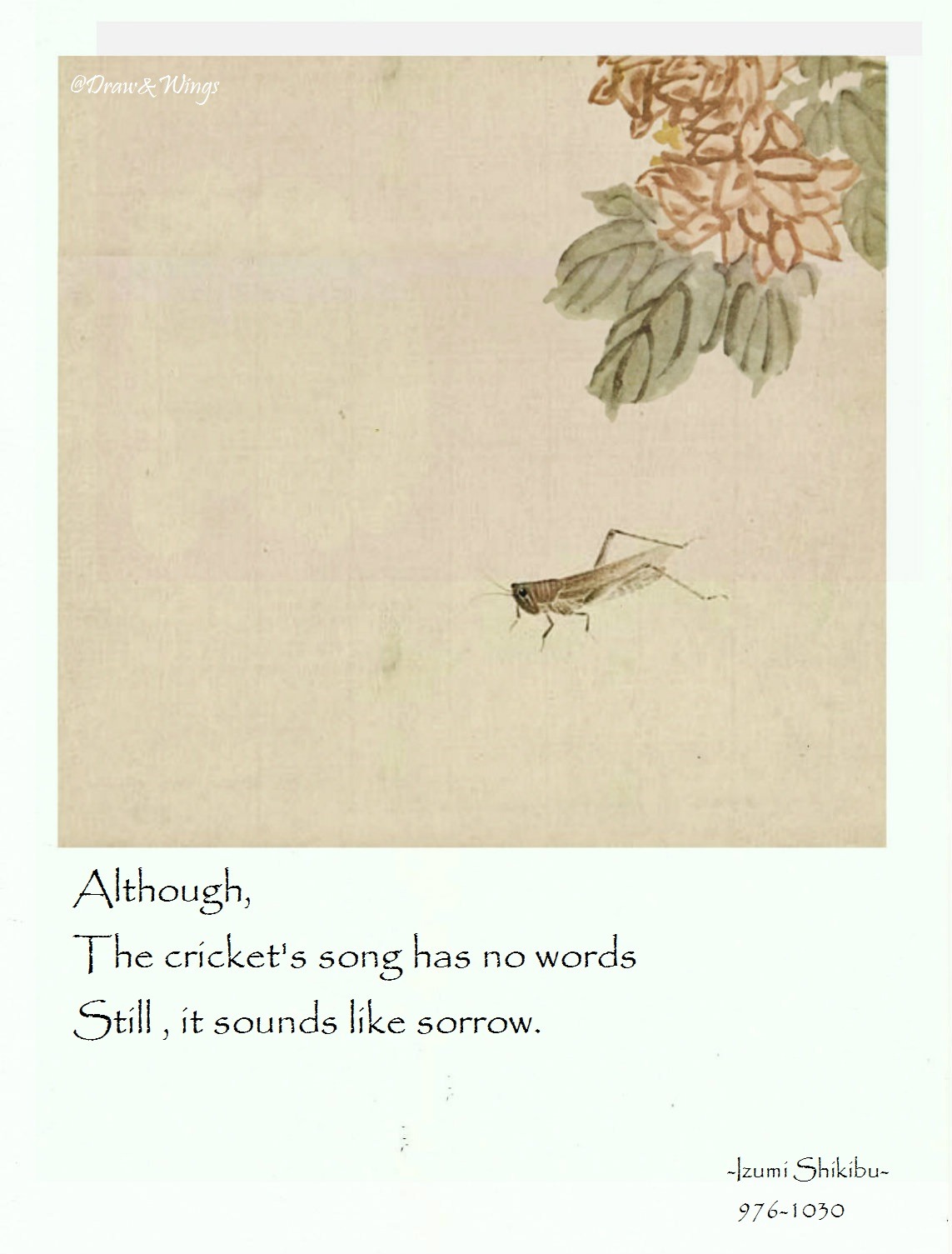
Haiku

What is haiku?


A poem in three lines,

With Seventeen syllables 

Of five, seven, five


~via Celebrity Death Haiku

Friday, October 28, 2022

Robots

Haiku by a Robot
by Nathan Beifuss, Age 9

Seven hundred ten
Seven hundred eleven
Seven hundred twelve.


And that reminded me of this:


Tuesday, December 14, 2021

Wayfinder

Wayfinder is a fun little app for iPhone/iPad.

It's kind of hard to fit it into a category.  It's not a "game," it's more of a "toy."  As you explore, flowers bloom in your wake and haikus are generated.

It's put out by The National Film Board of Canada, and is free to download and free of advertising.  You can learn about it by visiting their website, HERE.

Wednesday, July 31, 2019

And now, for something completely different…

I'm re-reading I Wait for the Moon:  100 Haiku of Momoko Kuroda, ©2014 by Abigail Friedman.  It does a wonderful job of placing the haiku in context and providing supporting details not generally known in the West.  The commentary really makes the haiku come alive, making it much more rich and colorful.

These two little passages were in reference to several haiku about cherry blossoms:

Each year as the cherry blossom season nears, the Japanese media provide daily updates on the evolving state of the cherry tree buds, reporting on the estimated time and date for the full bloom to occur in each prefecture and region of Japan.


As part of her effort to recommit to haiku, Momoku began a pilgrimage to Japan's one hundred most famous cherry trees.


I am envious.  I would love to live in a place that covered the blossoms blooming as a news story, and kept track of the 100 most wonderful cherry trees.

Wouldn't you rather hear about flowers blooming than about Donald Trump's latest tweet?

Thursday, December 31, 2015

Sunday, November 22, 2015

Brevity

Another excerpt by Billy Collins from his introduction  to Haiku in English, edited by Jim Kacian, ©2013:

Haiku is both easy and impossible to define.  One can merely use dictionary language to say that a haiku is a short poem, usually in three lines, that uses natural imagery to evoke a feeling or mood.  But such flat definitions fall well short of accounting for haiku's mysterious power to cause in the reader's consciousness a sudden shift, literally a new way of seeing.  Part of this ability lies in the form's brevity, which leaves no time to explain an experience; instead, the haiku conveys an experience directly without commentary and with an immediacy not possible in longer poems.

Saturday, November 21, 2015

Was Here

Billy Collins writes of haiku in the introduction to Haiku in English, edited by Jim Kacian, ©2013:

Many people don't get haiku.  They typically ask what the big deal is about a frog leaping into a pond or a piece of green pepper falling off a salad bowl.  So what indeed?  Maybe the best answer is a slap on the face, a common "answer" to a baffling koan.  But a more reasonable explanation of the "big deal" is the irreducible fact that the poet was there to witness the event.  A cherry tree in blossom and a dog barking in the distance may not seem to add up to much, but what such a haiku declares is that someone was present--actually there, living and breathing--at that particular intersection of sight and sound.  In that sense, haiku not only convey the beauty of individually experienced moments, they are also powerful little assertions of the poet's very existence.  Not to be present to witness the cherry tree and the barking dog means being absent, perhaps non-existent.  Every haiku makes a common claim:  I was there!  Like Kilroy with his nose over the fence.