Monday, February 22, 2016

Pursuing Happiness

In Why Be Happy When You Could Be Normal?  ©2011, Englishwoman Jeanette Winterson, intrigued that that the American constitution doesn't guarantee happiness, rather it guarantees the pursuit of happiness, expounds a bit:

Pursuing happiness, and I did, and I still do, is not at all the same thing as being happy-- which I think is fleeting, dependent on circumstances, and a bit bovine.


If the sun is shining, stand in it-- yes, yes, yes. Happy times are great, but happy times pass-- they have to-- because time passes.


The pursuit of happiness is more elusive; it is life-long, and it is not goal-centered.


What you are pursuing is meaning-- a meaningful life. There's the hap-- the fate, the draw that is yours, and it isn't fixed, but changing the course of the stream, or dealing new cards, whatever metaphor you want to use-- that's going to take a lot of energy. There are times when it will go so wrong that you will barely be alive, and times when you realize that being barely alive, on your own terms, is better than living a bloated half-life on someone else's terms.


The pursuit isn't all or nothing-- it's all AND nothing. Like all Quest Stories.

Sunday, February 21, 2016

Settle.

In this depressing excerpt from The Man Who Saved the Union:  Ulysses Grant in War and Peace by H.W. Brands ©2012, Representative Stevens explains why it's pointless to Hope and Dream:

But Thaddeus Stevens, though privately declaring the (14th) amendment a “shilly-shally bungling thing,” publicly explained that nothing better could be accomplished under present circumstances. “In my youth, in my manhood, in my old age,” he told the House, “I had fondly dreamed that when any fortunate chance should have broken up for a while the foundation of our institutions, and released us from obligations the most tyrannical that ever man imposed in the name of freedom, that the intelligent, pure and just men of this Republic, true to their profession and their consciences, would have so remodeled all our institutions as to have freed them from every vestige of human oppression, of inequality of rights, of the recognized degradation of the poor, and the superior caste of the rich. In short, that no distinction would be tolerated in this purified Republic but what arose from merit and conduct.” This dream, however, had vanished in the crucible of war and its terrible aftermath. “I find that we shall be obliged to be content with patching up the worst portions of the ancient edifice, and leaving it, in many of its parts, to be swept through by the tempests, the frosts, and the storms of despotism.” Stevens had reconciled himself to what was possible. “Do you inquire why, holding these views and possessing some will of my own, I accept so imperfect a proposition? I answer, because I live among men and not among angels.”

Saturday, February 20, 2016

"Try it."

My favorite exchange from Men in Black:
Jay:  You know what they say: "It's better to have loved and lost than never to have loved at all."
Kay:  Try it.

Keep your secrets here…

[embed]https://youtu.be/F0FXmbZcdkg[/embed]

Music for a Sleepy Saturday.

Full lyrics HERE.


Friday, February 19, 2016

Tangled

[embed]https://youtu.be/YAtA6rEpF40[/embed]

I heard this on the “Covers” channel of SomaFM, and it impressed me.  I really like it better than the original.

SomaFM is a great site to discover new music.  Visit them HERE.

Full song lyrics available HERE.

"Plus ça change…" Oh, never mind.

In The Man Who Saved the Union:  Ulysses Grant in War and Peace by H.W. Brands ©2012, General William Sherman is quoted describing the Southern middle class of the 19th century:

"They will want the old political system of caucuses, legislatures, etc., to amuse them and make them believe they are real sovereigns; but in all things they will follow blindly the lead of the planters."


That's interesting.  So the middle class thought they had political power, but in fact all power rested with the wealthy plantation owners.

What strange and unique times these people lived in!


Thursday, February 18, 2016

"Yet the contest proceeds."

People have always struggled to understand why God allows bad things happen.

In this excerpt from The Man Who Saved the Union:  Ulysses Grant in War and Peace by H.W. Brands, ©2012, Abraham Lincoln tries to make sense of the world:

"The President was in deep distress," Attorney General Edward Bates recorded.  "He seemed wrung by the bitterest anguish--said he felt almost ready to hang himself."  Lincoln had never been religious, but now he began searching for guidance from above.  "The will of God prevails," he mused privately.  "In great contests each party claims to act in accordance with the will of God.  Both may be, one must be wrong.  God cannot be for and against the same thing at the same time.  In the present civil war it is quite possible that God's purpose is something different from the purpose of either party."  The ways of the Almighty were inscrutable.  "He could have either saved or destroyed the Union without a human contest.  Yet the contest began.  And having begun, He could give the final victory to either side any day.  Yet the contest proceeds."

Tuesday, February 16, 2016

Preposterous

"It is preposterous to suppose that the people of one generation can lay down the best and only rules of government for all who are to come after them, and under unforeseen contingencies… The fathers would have been the first to declare that their prerogatives were not irrevocable."  ~Ulysses Grant on the U.S. Constitution, quoted in The Man Who Saved the Union: Ulysses S. Grant in War and Peace by H.W. Brands ©2012

Monday, February 15, 2016

Nova Scotia!

I'm not sure how it got started, but Mona and I have been playing a little game over the last few days where we replace song lyrics with the word "Nova Scotia."

Neither of us have ever been there, nor are we ever likely to go.

Anyway, our best efforts so far:

  • Nova Scotia Wants Me (Lord, I can't go back there) [based on]

  • Nova Scotia!  (of love) [based on]


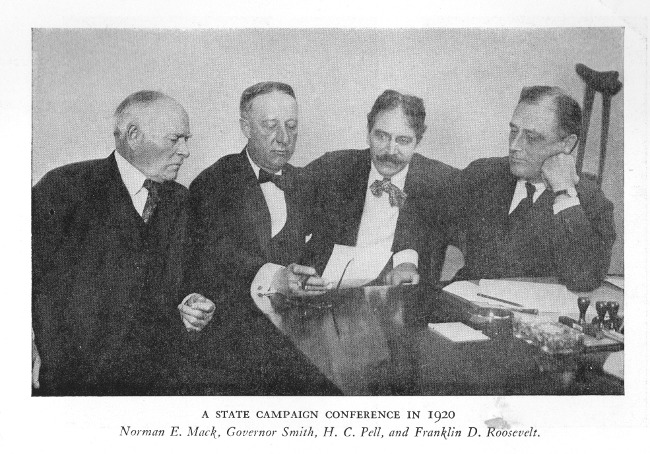
FDR


I had always heard that Franklin Roosevelt tried to hide his disability, but that doesn’t really seem to be the case.

Take this photograph, for example.  There were no “candid” photographs in 1920.   When a photographer was present, he’d be quite conspicuous setting up his tripod and lighting his flash powder.  Had Roosevelt been at all sensitive about his infirmity, he would have had ample time to simply lay his crutches on the floor.

But he didn't.

"Next door there is a dog with the waggiest tail!"

Mona mentioned my grandmother Kathleen to me last night, and I unexpectedly burst into tears.

I'm weird about emotions.  I admire people who can express them freely, but hold myself to another standard; when I express them, I immediately reproach myself:  "Stop being such a baby!  What's the matter with you?"

I have to remind myself that there's nothing the matter with me.  Emotions are what make us human.  Just don't take them too seriously.

In the last letter I ever sent her, I had told her that my cat Alice died, just short of her 20th birthday.  I had included a picture of myself in a big floppy hat, and at the time my beard reached halfway to my belt.

Below is the last letter Kathleen sent to me.  She died just a few days later, at the age of 98.

I'd like you to meet her:

Kathleen 20080511_0001 Kathleen 20080511_0002 Kathleen 20080511_0003

Number 9, Number 9, Number 9…

Amendment № 9 to the U.S. Constitution is pretty simple.  Here it is in its entirety:

The enumeration in the Constitution, of certain rights, shall not be construed to deny or disparage others retained by the people.


People who profess to believe in a "strict interpretation"  like to pretend it doesn't exist, because it invalidates their premise.

It's saying that you can have a right to an abortion even if that's not specifically spelled out.  You have a right to privacy, even if it's not specifically spelled out.  You have a right to get married, even if it's not specifically spelled out.

When congress vets the replacement for Antonin Scalia, a good question would be, "Please list for us some rights not enumerated in the constitution which are nonetheless retained by the people."

Saturday, February 13, 2016

"I don't know where you are…"

[embed]https://youtu.be/GbvcKvy8RqI[/embed]

Sadly, he’s right:  if a girl hasn’t called you back in two years, it’s time to dump her.

Full lyrics HERE.

Monday, February 8, 2016

Mis/Pre

I'm reading a biography of 17th century priest/scientist Athanasius Kircher, A Man of Misconceptions:  The Life of an Eccentric in an Age of Change by John Glassie, ©2012.

The book is written in kind of a condescending tone, "Ha ha, let's all laugh at the buffoon who got everything wrong," but I don't think that's entirely fair.

Father Kircher was a brilliant, inquisitive man whose observations of the world didn't  match what he had been taught was true.  Instead of changing his mind, he changed his data.

How many of us are completely innocent of that sin?  How many of us are committing that sin as he was: without even being aware of it?