Thursday, February 4, 2016

Preconceived Notions

Excerpted from John Glassie's excellent biography of Athanasius Kircher, A Man of Misconceptions ©2012:

In 1610, twelve years before Kircher arrived in Cologne, Galileo Galilei, a mathematics professor in Padua, published a slim volume, Starry Messenger, about the observations he'd made with a new instrument he called the perspicillium, or the telescope.  It was a very much improved-upon version of the spyglasses that had recently begun to appear in Europe.  The configuration (a concave lens at one of a tube, and a convex lens at the other) was fairly simple, but Galileo's handcrafted device made things appear, as he wrote, "nearly one thousand times larger and over thirty times closer" than they would with the naked eye.  Among other discoveries, he observed four moons revolving around Jupiter.  The most basic implication of this was clear to any student of natural philosophy willing to admit it.  (At the Jesuit school of La Flèche in Anjou, a student named René Descartes is said to have written a sonnet celebrating the news.)  If moons revolved around Jupiter, maybe earth wasn't really the center of the universe, around which everything revolved.  Galileo also reported that "the moon is not robed in a smooth and polished surface," as Aristotelian doctrine had it, "but is in fact rough and uneven, covered everywhere, just like the Earth's surface, with huge prominences, deep valleys, and chasms."


The Church seemed willing at first to consider these findings.  Clavius and other Jesuit astronomers held a reception for Galileo in Rome, and while Clavius declared telescopes "troublesome to operate," he confirmed the existence of moons around Jupiter.  On the question of the rough surface of the moon, however, the seventy-one-year-old astronomer couldn't bring himself to believe his eyes.  Perhaps the moon was just unevenly dense, he suggested.  In a letter to the Church's chief theologian, a group of Jesuit astronomers wrote together that they were "not sufficiently certain" about the matter.  In other words, preconceived notions were such that Clavius couldn't see through a telescope what modern people, who know the truth, can recognize with the naked eye.

Wednesday, February 3, 2016

The Universal Declaration of Human Rights

The United States is in violation of quite a few of its articles, but The Universal Declaration of Human Rights is still worth reading from time to time, to remind ourselves of what we once aspired to.

You can download it in PDF format HERE.

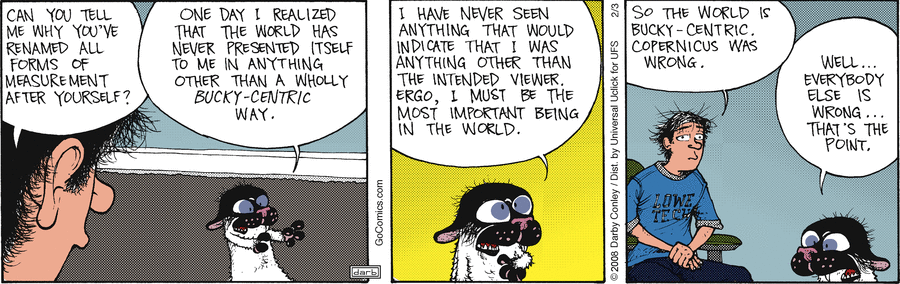
Solopsism


Ironically, Bucky is not the only one who sees the world through that lens.

Get Fuzzy is on the web HERE.

Tuesday, February 2, 2016

Allez hop!

[embed]https://youtu.be/K6HrLN32hvw[/embed]

1977 had it's moments.


"We call this…"

"We sometimes use the Buddhist practice of telling (our daughter) Clea 'We call this a tree,' instead of 'This is a tree.'"  ~William Powers, in the March 2016 issue of The Lion's Roar

Monday, February 1, 2016

"A joyful extension of identity."

Excerpt from "Compassion is our only choice" by Norman Fischer, in the March 2016 issue of The Lion's Roar:

No doubt the most important teaching the world needs to hear from Buddhism-- and from all our world religions-- is compassion.


The Buddhist teachings on love and compassion are, as far as I can tell, unique and radical.  They say that others are one's self, and that one's self is others.  So the best way to take care of yourself is to take care of others, and vice versa.


This teaching has two practical consequences.  First, it means that caring for others isn't guilt-ridden self-sacrifice.  It's a joyful extension of identity.


Helping doesn't have to be a big deal.  It simply means taking care of what requires care in an ordinary way.  This is natural and normal, once you see that we really are one body, not a bunch of contending individuals.  It is as natural and normal to use Shantideva's metaphor, as our fingers pulling a thorn out of our foot.


Second, the Buddhist teachings on compassion mean there are infinite ways we can help, in obvious as well as non-obvious ways.  The truth is that everyone, regardless of means and capacity, can practice compassion as part of a world movement for the inclusion and benefit of all.  This means caring for others, benefiting them, and doing whatever we can to ensure a world in which there is more justice and more love than ever before.

Annunciate

"Years of opera training will make you pronounce your g’s, t’s, d’s and all the other hard consonants that everyone forgets about. It’s like sex: I do it because it feels good. Go ahead and properly pronounce all the words in your sentences for a full day, it feels like talking dirty. It’s like chocolate, or silk, or creamy smooth custard. Annunciation almost feels perverse. I love it."  ~Bonnie Montleon (via)

Saturday, January 30, 2016

Our house, is a very very very fine house…

I had a very vivid dream a few nights ago, about houses.

My first house was a tacky 70s aesthetic, filled with lots of vinyl furniture.  It was kind of ugly, but functional.  Vinyl furniture is uncomfortable on hot days, but easy to clean.

I left and came back, and it had been transformed into a movie theater.  Everyone knew me, but I had to wait in line to get a glass of Pepsi.  It was warm inside.  There was carpet.

I left and came back, and it had been transformed into a two-story house filled with fishing gear.  It had wooden walls and floors, and a second story balcony.  It was beautiful.  I never wanted it to change-- but it did.

I left and came back, and now it was an auditorium filled with relatives.  A family reunion was going on.  Some people I hadn't seen in years, some had even passed on, but they were all there enjoying each others company.  The light was yellow...

I've been reading a lot Buddhist texts about change, so I suppose it's not unusual that my subconscious would create its own metaphor.  Maybe I'm trying to tell myself something.

Change is going to come rapidly to my life.  Some changes I'll enjoy, many I won't.

But it is inevitable.  The best strategy will be to make the most of whatever house I find myself in, while remaining aware that tomorrow's house may be very, very different.

Friday, January 29, 2016

And she could laugh away the dark clouds…

[embed]https://youtu.be/R7JPwznm6e4[/embed]

On this the first anniversary of Rod McKuen’s death, here is Johnny Cash covering one of his songs.

Full lyrics HERE.

Tuesday, January 26, 2016

"Other than the burning eyes and cancer, it's quite safe."

From the Tyler Morning Telegraph:

This month's water bill comes with some added reading material - a glossy four-page color pamphlet explaining recent issues with the city's water supply and assuring residents the water is safe.


Apparently, this is some new definition of “safe” that I haven’t heard before, because what the pamphlet actually says is that the water can irritate our eyes and increase our risk of cancer.

The pamphlet goes on to suggest that if burning eyes and cancer are unacceptable to us, we should buy and install filters to remove the haloacetic acid.

Control

Brief excerpt from The Restaurant at the End of the Universe by Douglas Adams, ©1980:

"Listen, Ford," said Zaphod, "everything's cool and froody."


"You mean everything's under control?"


"No," said Zaphod,  "I do not mean everything's under control.  That would not be cool and froody."

Friday, January 22, 2016

Eve


I watched Elizabeth Lev's TED Talk about the Sistine Chapel, and one thing she pointed out-- which I had never been shown before-- is that as God is about to give Adam the spark of divinity with His right hand, His left arm is already wrapped snugly around Eve.


Cultivate your garden

Excerpt from Douglas Adams' The Hitchhiker's Guide to the Galaxy:

"You know," said Arthur thoughtfully, "all this explains a lot of things.  All through my life I've had this strange unaccountable feeling that something was going on in the world, something big, even sinister, and no one would tell me what it was."


"No," said the old man, "that's just perfectly normal paranoia.  Everyone in the Universe has that."


"Everyone?" said Arthur.  "Well, if everyone has that perhaps it means something!  Perhaps somewhere outside the universe we know…"


"Maybe.  Who cares?" said Slartibartfast before Aurthur got too excited.  "Perhaps I'm old and tired," he continued, "But I always think that the chances of finding out what really is going on are so absurdly remote that the only thing to do is to say hang the sense of it and just keep yourself occupied."